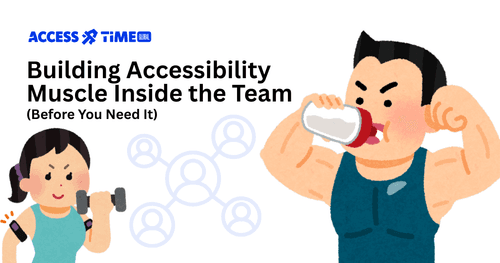
Building Accessibility Muscle Inside the Team (Before You Need It)
Prasaja Mukti - Accessibility UX Writer
●●
Most teams do not ignore accessibility on purpose. What usually happens is simpler, and more human.
There is a deadline.
A launch window.
A client expectation.
Accessibility gets mentally parked as something important, but not urgent. Something to address later, when there is more time, more budget, or more clarity.
The problem is that accessibility does not respond well to urgency. It rewards preparation, not panic. Teams that only think about accessibility when regulations tighten, audits arrive, or complaints surface are already paying the highest possible cost. Mature teams take a different approach. They build accessibility muscle early, quietly, and continuously. Long before they “need” it.
Accessibility Is Muscle Memory
Accessibility is often framed as a body of knowledge. Guidelines to memorize. Checklists to follow. WCAG criteria to reference. In practice, that framing is incomplete.
Real accessibility lives in habits. In how a designer structures a layout by default. In how an engineer names components and handles states. In how a writer avoids visual-only instructions without thinking twice. That is muscle memory. And muscle memory is built through repetition, not last-minute learning.
Teams that treat accessibility as a one-off training session or a compliance sprint tend to forget it under pressure. Teams that integrate it into daily workflows carry it forward naturally, even when things move fast.
Why Waiting Is the Most Expensive Option
Many organizations assume they can “add accessibility later.” Technically, this is sometimes true. Practically, it is almost always painful.
When accessibility is introduced late, teams are forced to unlearn habits.
Design patterns need to be reworked. Copy must be rewritten. Components that were never meant to support keyboard navigation or assistive technologies need structural changes.
By contrast, teams that build accessibility capability early rarely see it as overhead. It becomes part of how they design, build, and review work. Not because they are idealistic, but because it reduces friction later.
Accessibility as a Team Capability, Not a 'Specialist' Dependency
Another common pattern is outsourcing accessibility entirely to specialists. Auditors find issues. Consultants write reports. Teams fix what they are told to fix. This can work tactically, but it creates a dependency problem.
The team does not grow. They comply, but they do not learn.
Building accessibility muscle means shifting from external correction to internal capability. Designers understand why certain patterns fail. Engineers recognize accessibility regressions during development. Writers spot problematic phrasing before it ships.
This does not require everyone to become an accessibility expert. It requires shared literacy. Enough understanding that accessibility concerns surface naturally during planning, design reviews, and QA.
Calm Teams Are Trained Teams
There is a noticeable difference between teams that are trained in accessibility and teams that are not. Untrained teams tend to react emotionally when accessibility is raised. The conversation feels heavy. Defensive. Overwhelming. And then there's the trained teams that respond calmly. They ask better questions, articulate trade-offs eloquently, and know what they can fix immediately and what needs planning.
That calmness is the result of familiarity.
Training removes fear. It turns accessibility from an abstract obligation into a concrete skill set.
What Internal Accessibility Training Actually Looks Like?
Effective accessibility training is not about dumping standards onto people. It is about contextual learning.
Designers need to understand how accessibility influences hierarchy, interaction, and visual decisions. Engineers need to see how small implementation details affect real users. Writers need to practice describing actions without relying on visual cues. Most importantly, training should connect accessibility to the team’s actual work (design systems, tech stack, content patterns., even release cycles). That is where accessibility becomes actionable.
At AccessTime, we focus on helping teams build accessibility capability where it matters most, inside the team.
Our internal training programs are designed to meet teams at their current level and context. We do not aim to turn everyone into a specialist. We aim to help teams develop shared instincts, practical awareness, and confidence.
Training is often paired with real product examples, hands-on exercises, and discussions grounded in daily workflows. The goal is to build fluency. When teams internalize accessibility, audits become easier, fixes become smaller, conversations become calmer. And ultimately, accessibility stops being something you scramble for when pressure arrives.
Building Before You Need It
Accessibility muscle is easiest to build when there is no crisis. Realistically speaking, before legal risk escalates, rework piles up, or trust erodes, is the best time to go to accessibility gym that your team initiate.
Teams that invest early rarely regret it, because accessibility is something you grow into.
Contact Us
Ready to explore how accessibility can transform your products? Visit our contact page to learn more about AccessTime consultancy services, or try Access Lens to get started with a fresh perspective on what's possible.
Share: