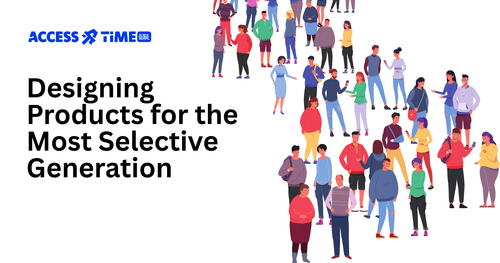
Designing Products for the Most Selective Generation
Prasaja Mukti - Accessibility UX Writer
●●
We'll talk about Gen Z, a generation that isn't hard to reach. They're just hard to fool.
A lot of teams talk about "reaching Gen Z" like it's a targeting problem. Find the right channel, the right format, the right creator, and they'll show up. That framing isn't wrong exactly. It just misses the more fundamental issue: Gen Z doesn't have a discovery problem. They have a trust problem. With you, specifically, until you prove otherwise.
This is a generation that grew up entirely online. They've seen every dark pattern, every fake urgency countdown, every brand that posted about a cause and went quietly back to business as usual. They're calibrated, and the products that earn their attention tend to understand that distinction.
The experience speaks before the copy does
Gen Z forms an opinion about your product before they've consciously evaluated it. Load speed, mobile feel, whether the interactions are native or ported-over, these register immediately. Their threshold for "this feels off" is low, because they've used thousands of apps and they know what a good one feels like.
If your product is slow, clunky on mobile, or has moments that feel slightly out of place, they're gone. Not angry, just gone. They won't file a support ticket. They'll just never come back. For this audience, UX quality is a marketing channel. A product that feels good to use gets shared. One that doesn't gets quietly abandoned.
Community over broadcast
Gen Z trusts people over brands, almost categorically. Not influencers in the traditional sense, but they've become good at detecting paid inauthenticity there too. What they trust is someone who genuinely uses your product talking about it in their own voice, in a community they already belong to.
A real recommendation in a Discord server or a niche forum reaches further, per impression, than most paid media. It's slower and harder to manufacture. That's exactly why it works. The more useful question isn't "how do we market to Gen Z communities?", it's "are we building something a community would form around naturally?"
If the answer is no, that's a product problem. Not a marketing one.
Values are a consistency test, not a campaign
Gen Z cares about inclusion, authenticity, and whether companies actually do what they say. The mistake most teams make is treating this as a messaging challenge. Gen Z sees the product, the interface, the cancellation flow, the notification design, all of it. They're not grading on intent. They're grading on consistency.
You don't have to be perfect. You do have to be honest about where you are and visibly moving in the right direction. There's more trust in "here's what we're working on" than in "we believe in a better world."
A few things worth checking
-
Use your product on your phone, on a slow connection, with one hand. That's often the real Gen Z experience. What breaks?
-
Find where your product is talked about organically. Reddit, Discord, TikTok comments. What are people actually saying? That's your real positioning.
-
Audit your onboarding for anything coercive. Fake urgency, guilt-trip cancellation, notification prompts before the user has seen any value. Gen Z spots these fast.
-
Ask whether your values show up in the product itself, not just the about page. Inclusion and accessibility are product decisions before they're marketing ones.
Gen Z isn't a mysterious audience with a special playbook. They're a generation that grew up with enough product experience to know the difference between something built for them and something built to extract from them. Build something genuinely good, be honest about what it is, and let people who love it talk about it in their own words. That's not a Gen Z strategy. It's just a good product strategy, and it turns out they respond to it particularly well.
Contact Us
Ready to explore how accessibility can transform your products? Visit our contact page to learn more about AccessTime consultancy services, or try Access Lens to get started with a fresh perspective on what's possible.
Share: