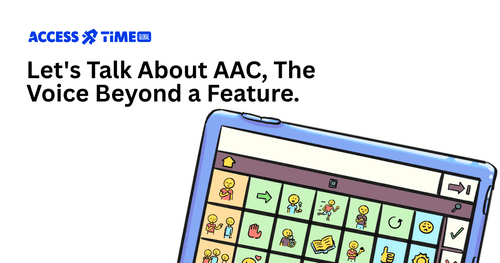
Let's Talk About AAC, The Voice Beyond a Feature.
Prasaja Mukti - Accessibility UX Writer
●●
What a mother, her son, and a button that speaks taught us about building for real communication.
At AccessTime, we build accessibility-first software. That means we spend a lot of time thinking about barriers, the ones in interfaces, in systems, in assumptions baked into design decisions made long before a user ever touches a screen.
But on this May, at the Apple Developer Academy event in celebration of GAAD 2026, I met a barrier that no amount of good engineering can fully solve on its own.
It's the barrier of whether people are willing to wait.
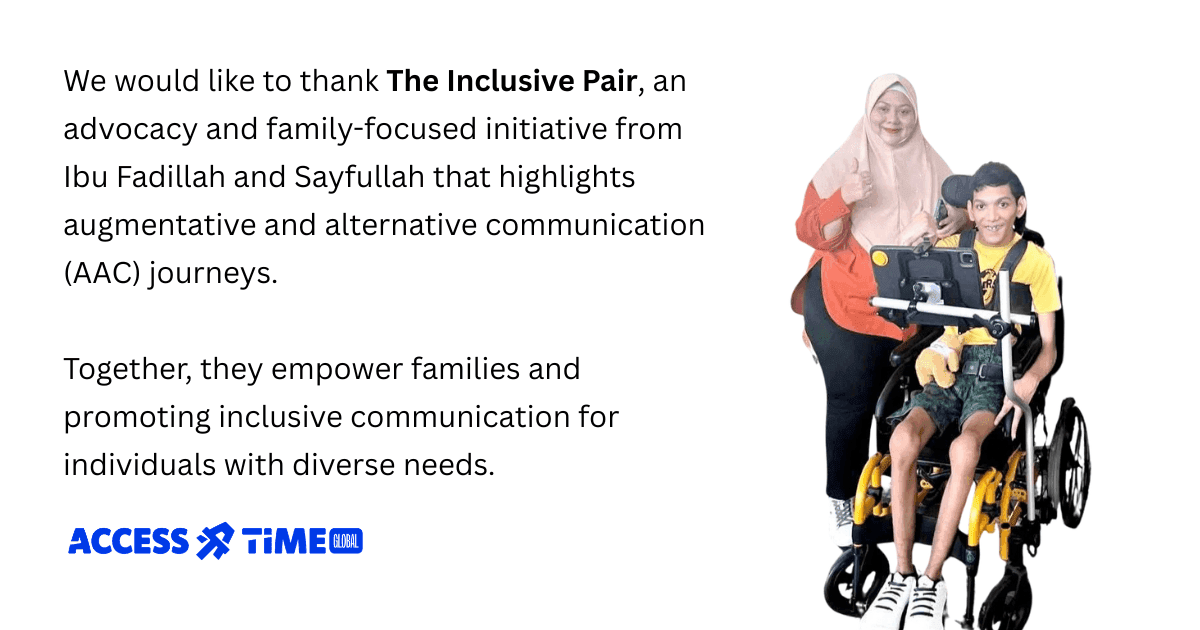
I met Sayfullah and his mother, Ibu Fadillah (known online as The Inclusive Pair) at the event. Sayfullah communicates through AAC: Augmentative and Alternative Communication. A device. An app. A vocabulary built carefully over time that has become, in the most literal sense, his voice.
And seeing their presentation, listening to how that voice came to be, I kept thinking about how we in the tech industry talk about accessibility like it's a checklist. What Ibu Fadillah described is something much harder to ship.
First, what AAC actually is (and isn't).
AAC is any way a person communicates besides using their mouth. Pointing to pictures. Head nods. Eye blinks. Typing on a tablet. Pressing buttons that speak out loud. For people whose speech is unclear or absent, AAC isn't a workaround. It's language.
When I asked what AAC made possible that wasn't possible before, Ibu Fadillah didn't reach for clinical terms. She said: "It gave Sayfullah a voice that was never heard before. A personality that was not seen. Most importantly, his freedom and confidence."
That word — freedom — is the one we should be designing toward.
Practically, this looked like: Sayfullah participating in family conversations. Saying hi to people. Stating preferences. Voicing ideas and opinions that made daily conversations genuinely interesting, not in the patronizing sense, but in the real one, the sense where you actually want to know what someone thinks.
That's not a medical outcome. That's a human one. And it's the kind of outcome we should be measuring ourselves against at AccessTime.
What good design actually feels like in this context.
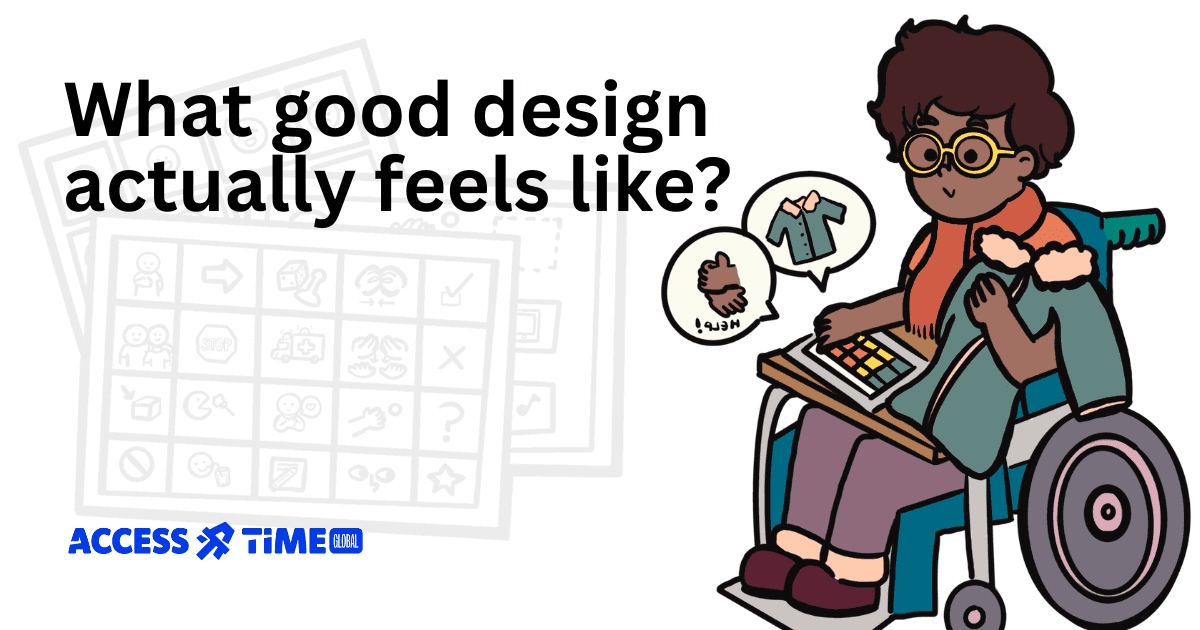
When I asked what makes an AAC tool genuinely good, the answers were deceptively quiet. No flashy features. No AI pitch.
A clear, predictable layout, because AAC users often remember where words live spatially on a screen. Move things around and you've made communication slower and more tiring. A natural conversational rhythm. Efficient navigation, because nobody should need many taps to say something urgent. Readable symbols. Consistent colors.
And this: the capacity for jokes. For sarcasm. For cultural phrases and personal interests.
"Communication is personality," she told me.
That line should be printed and pinned above every product team's monitor. Because a device that can only express needs has quietly decided what kind of person its user is. It has put a ceiling on their identity. And that is a design failure, even if every accessibility guideline is technically met.
There's also a physical reality that designers rarely account for. A spoken sentence takes seconds. An AAC sentence can take a minute. That minute is full of intention. It asks something of the people around it, patience, presence, the discipline not to fill the silence.
"People tend to overlook how physically exhausting AAC can be," she said.
We do. And we build products that reflect that oversight.
The gaps that still exist, and why they matter to us.
At AccessTime, multilingual and regional support isn't an edge case. It's the brief. So when Ibu Fadillah described how most AAC systems are built primarily in English, I felt that as a direct indictment of an industry we're part of.
For examples, families in Indonesia navigating with Bahasa Indonesia, regional dialects, and the specific cultural texture of everyday life. An English-first device isn't just inconvenient, it's exclusionary in ways that compound daily.
There's more, of course. A lot of devices aren't built for noisy environments. She now carries a Bluetooth speaker to make Sayfullah's voice audible in public spaces. Affordability remains a persistent barrier )most apps aren't locally made, most devices aren't locally priced). And ongoing support like training, repairs, caregiver resources largely falls on families to figure out alone.
But she named something even harder to solve: "Sometimes the biggest barrier is not the device. It is whether people are willing to wait, listen, and presume competence."
Presume competence. Assume the person communicating through a device understands you, has thoughts worth hearing, is a full participant in this conversation. Don't switch to speaking to the caregiver mid-sentence. Don't finish their sentence. Stay in the room, even when the room gets quiet.
No SDK ships that. It has to come from culture. And culture, in products, comes from the people who build them.
What genuine commitment looks like versus checkbox accessibility.
Most organizations still treat accessibility as an add-on. Something applied at the end, after the real decisions are made, by someone whose job title includes the word "compliance." It gets QA'd. It gets documented. It does not get understood.
When we asked what genuine support for AAC adoption would look like, the answer was structural:
Involve AAC users from the start, not as testers at the finish line, but as partners in framing the problem. Test in real environments: schools, homes, public spaces, not just labs. Invest in community-driven vocabulary, in tools that let families safely add language, in regional and multilingual support built into the architecture, not bolted on afterward. Build repair pathways. Build caregiver support. Build for the full ecosystem of people around a device, not just the device itself.
"The best innovations usually happen when AAC users and families are involved directly in designing the technology from the beginning."
This is the practice we try to hold ourselves to at AccessTime. Not because it's good PR (though we hope it is) but because the alternative is building things that work in demos and fail in lives.
What we're taking back.
I left that conversation thinking about a question Ibu Fadillah said nobody ever asks her.
Not in a training session. Not in a product survey. She wishes someone would ask, in the middle of a real conversation: "What does it feel like to communicate through AAC?"
As an accessibility-first software house, we spend a lot of time asking what features work. We should probably spend more time asking what it feels like.
Pause. Stay. Don't assume.
Those aren't UX principles. They're what Sayfullah's device asks of everyone around him, every single day. And they might be the most honest brief any of us in this industry has ever been given.
Sayfullah and his mother Ibu Fadillah share their AAC journey at @theinclusivepair. AccessTime met them at the Apple Developer Academy event in celebration of GAAD 2026. Follow their journey at @theinclusivepair
We build accessibility-first software, because access is not a feature. It's a right.
Contact Us
Ready to explore how accessibility can transform your products? Visit our contact page to learn more about AccessTime consultancy services, or try Access Lens to get started with a fresh perspective on what's possible.
Share: