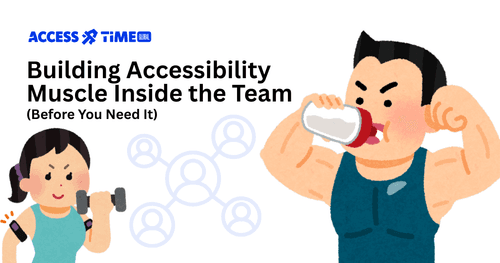
How Apple's Accessibility Nutrition Labels Redefines the App Store
Prasaja Mukti - Accessibility UX Writer
●●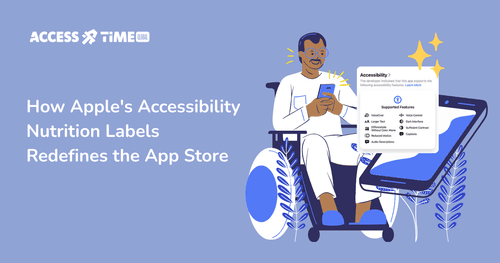
Every few years, a platform introduces a feature that looks deceptively simple but fundamentally reshapes how products are built, marketed, and evaluated. Apple’s Accessibility Nutrition Labels are one of those features.
At a glance, they are just a section on an App Store page: a neat list showing whether an app supports accessibility features such as VoiceOver, Voice Control, Larger Text, captions, reduced motion, high contrast modes, and more. But beneath that surface lies something deeper. Apple has turned accessibility from a behind-the-scenes technical effort into a front-of-house value proposition.
In a glance, this is a UI update. But beyond that, this is also a shift in how software competes.
The Clarity Users Never Had Before
For a long time, accessibility information was either unavailable, buried in documentation, or discovered only after frustration.
A person relying on assistive technology couldn’t easily know if an app would work for them until after they downloaded it. It was trial by error, costly in time and often discouraging.
Accessibility Nutrition Labels solve this instantly.
-
They give people clarity before commitment.
-
They let users filter based on their needs.
-
They turn accessibility into a true search and comparison feature.
Whether someone needs VoiceOver to navigate, relies on captions to consume media, or adjusts text sizes to 200 percent, the information is now visible at the decision point.
And once clarity enters a market, behavior changes.
A Benefit for Far More Than People With Disabilities
One of the most overlooked truths in accessibility is that its benefits ripple outward to everyone. Accessibility Nutrition Labels amplify that understanding.
-
A parent trying to use an app hands-free can now look for Voice Control support.
-
A commuter who prefers captions in noisy environments knows which video apps accommodate them.
-
A senior user comparing readability can immediately find apps that adjust text sizes and contrast.
The label democratizes accessibility information because accessibility itself is democratic. Even people who don’t identify as disabled benefit from knowing which apps adapt, flex, and respond to real-life constraints. Good accessibility signals good usability.
The Business Advantage Hidden in Plain Sight

When Apple introduced privacy labels, the initial reaction was skepticism. Over time, those labels became a trust signal. Apps with transparent privacy practices earned credibility, while vague disclosures raised suspicion.
Accessibility Nutrition Labels will follow the same pattern.
For businesses, the benefits are immediate and quantifiable:
-
Increased discoverability Apps that declare strong accessibility support appear in more relevant search results. When users search “VoiceOver budgeting app” or “games with captions,” Apple elevates apps with accurate labels. Visibility becomes a competitive advantage.
-
A wider addressable market More than a billion people globally live with disabilities. Millions more have temporary or situational accessibility needs. Labels give them (and everyone around them) a reason to choose your app over a competitor’s.
-
Stronger enterprise appeal Schools, workplaces, and public institutions often have accessibility requirements. With Apple’s labels, compliance becomes visible. If your app publicly supports the features institutions need, procurement becomes easier.
-
Differentiation in crowded categories When every to-do list app looks similar, accessibility becomes a meaningful differentiator. Suddenly, a “basic” feature like Larger Text or Dark Interface is not a minor setting anymore, it’s a reason to choose one product over another.
-
Higher trust, lower churn Users who know an app supports their needs before downloading are far more likely to stay. The label reduces false expectations, disappointment, and deletion.
By formalizing accessibility disclosures, Apple is protecting users, but it’s also giving businesses a new way to express craftsmanship and care.
Internal Alignment Through Public Accountability
One of the quiet powers of the Accessibility Nutrition Label is internal, because teams must align to declare anything publicly. Apple requires developers to verify that users can complete all common tasks (from onboarding and login to core functionality) using each accessibility feature they claim to support.
This forces product teams to assess accessibility not as a patch or enhancement, but as a core system of the app.
Design must consider contrast and readable type.
-
Engineering must use semantic elements and native APIs.
-
QA must validate accessibility the same way they validate performance.
-
Marketing must speak about accessibility accurately.
The label creates a shared truth inside a company: we can only claim what we truly support.
A Platform-Level Signal: Accessibility Is Now Part of the Shelf
-
Think about how people choose food in a grocery store.
-
Calories. Allergens. Ingredients. Serving size.
Labels don’t force people to choose healthy food, but they create informed decisions, and businesses adapt accordingly.
Apple is doing the same for digital products.
Once accessibility is displayed on the “shelf,” users begin comparing.
-
Once users compare, they prefer apps that support their needs.
-
Once preference shifts, businesses follow.
This is how industries evolve. Not through mandates, but through market expectation. The label is not the change. The behavior it triggers is.
An Ecosystem-Wide Ripple
Apple is also expanding tools across the platform: Magnifier on Mac, Braille Access, richer transcription, improved math input for braille, and deeper system-level support for assistive technologies.
This sends a clear message:
-
Accessibility is not a specialty feature.
-
Accessibility is core to the Apple experience.
The more Apple invests, the more users engage. The more users engage, the more developers must respond. The platform is becoming more inclusive by design.
A Future Where Labels Are the Norm
Right now, Accessibility Nutrition Labels are new and voluntary. Soon they won’t be. Apple has already stated that declaring accessibility support will be required for submitting apps and updates.
This will normalize accessibility transparency across the industry the same way privacy labels did. Eventually, users will expect accessibility labels everywhere, not just on the App Store.
Companies that build early will earn trust before the market fully shifts. Companies that wait will spend years catching up.
This is not simply about compliance, but more towards professionalism, product quality, and competitive advantage.
The Label Is Small. The Impact Is Not.
Apple’s Accessibility Nutrition Labels take something that used to be invisible and make it visible. They give users agency, give developers accountability, and give businesses a differentiator they never had before.
This is what meaningful product innovation looks like, a small UI pattern that unlocks a larger cultural change. And when users make choices with that clarity, the market will follow.
Contact Us
Ready to explore how accessibility can transform your products? Visit our contact page to learn more about AccessTime consultancy services, or try Access Lens to get started with a fresh perspective on what's possible.
Share: