The Fastest Teams Are the Ones Who Decide Earlier About Accessibility
Prasaja Mukti - Accessibility UX Writer
●●
There is a persistent myth in product teams and software houses that accessibility is a drag on speed. That it adds meetings, checklists, edge cases, and review cycles that slow delivery. It is usually framed as a trade-off:
"You can move fast, or you can be accessible. Pick one."
What this framing misses is that most teams are not actually slowed down by accessibility. They are slowed down by ambiguity. Accessibility just has a habit of exposing that ambiguity earlier, when it is still uncomfortable, visible, and cheap to fix.
Speed Is Lost to Ambiguity, Not to Standards
Teams that work accessibility-first tend to move faster not because they write less code or design fewer screens, but because they argue less later. They are forced to make decisions early about hierarchy, interaction, copy, focus order, error handling, and state changes.
Those decisions, once made, remove entire categories of debate that otherwise resurface during QA, UAT, legal review, or post-launch support.
Accessibility redistributes friction to the front, where it belongs.
Most teams have experienced the slowest kind of work,
the unplanned rework
.
- A button that “felt obvious” but becomes ambiguous in testing.
- A form that looks complete but collapses under keyboard navigation.
- A modal that is visually clean but traps focus.
- Copy that sounds fine until someone asks what happens when it fails, retries, or partially completes.
These are rarely accessibility problems in isolation. They are clarity problems. Accessibility simply refuses to let them stay hidden.
Accessibility Forces Decisions You Were Avoiding Anyway
When a team commits to accessibility early, certain questions can no longer be postponed.
What is the primary action on this screen?
What happens first when a user lands here?
Where does focus go next?
How is success communicated, and how is failure explained?
Does this interaction still work without a mouse?
Does this copy still make sense when read aloud, out of visual context?
Accessibility makes these questions unavoidable.
Teams that do not ask them early still end up answering them. They just do it later, under time pressure, with more stakeholders involved, and often with less room to change the underlying structure. Accessibility-first teams answer them when change is cheap—
because that is the real speed advantage
.
“Accessibility Slows Us Down” Is a Tell
There is a useful provocation here. Accessibility slows teams down only if they are used to being vague. If a team relies on visual implication instead of explicit structure, accessibility will feel restrictive. If a team depends on “we’ll figure it out later,” accessibility will feel bureaucratic. But if a team already values precision, accessibility becomes an accelerator. It locks intent early and reduces downstream uncertainty.
This is why resistance to accessibility often correlates with unclear ownership and fuzzy decision-making. Accessibility actually exposes problems, and exposure feels like friction only if the underlying system is fragile.
QA Churn Is Where Time Actually Disappears
One of the biggest hidden costs in software delivery is QA churn.
Not bugs, but debates.
Is this expected behavior or a defect? Is this copy intentional or provisional? Is this interaction broken or just undocumented?
Accessibility-first teams reduce this churn because behavior is specified, not implied. WCAG success criteria, when used properly, function as shared behavioral contracts. They define what must happen, not just what should look good.
As a result, QA becomes verification instead of negotiation. Fewer issues bounce back and forth between teams. Fewer tickets exist solely to clarify intent. That is not slower delivery and it actually create less waste.
Accessibility as a Neutral Language Between Disciplines
Cross-team friction often comes from misaligned assumptions. Designers optimize for clarity, engineers for feasibility, product managers for scope, writers for tone. Accessibility provides a neutral framework that cuts across all of them.
Semantic hierarchy reduces subjective design debates. Operability requirements ground engineering decisions. Clear error messaging aligns content with system behavior.
Instead of arguing preferences, teams reference shared criteria. This does not remove discussion but makes discussion more productive. Decisions converge faster because they are anchored to user capability rather than internal taste.
Better Estimates, Fewer Surprises
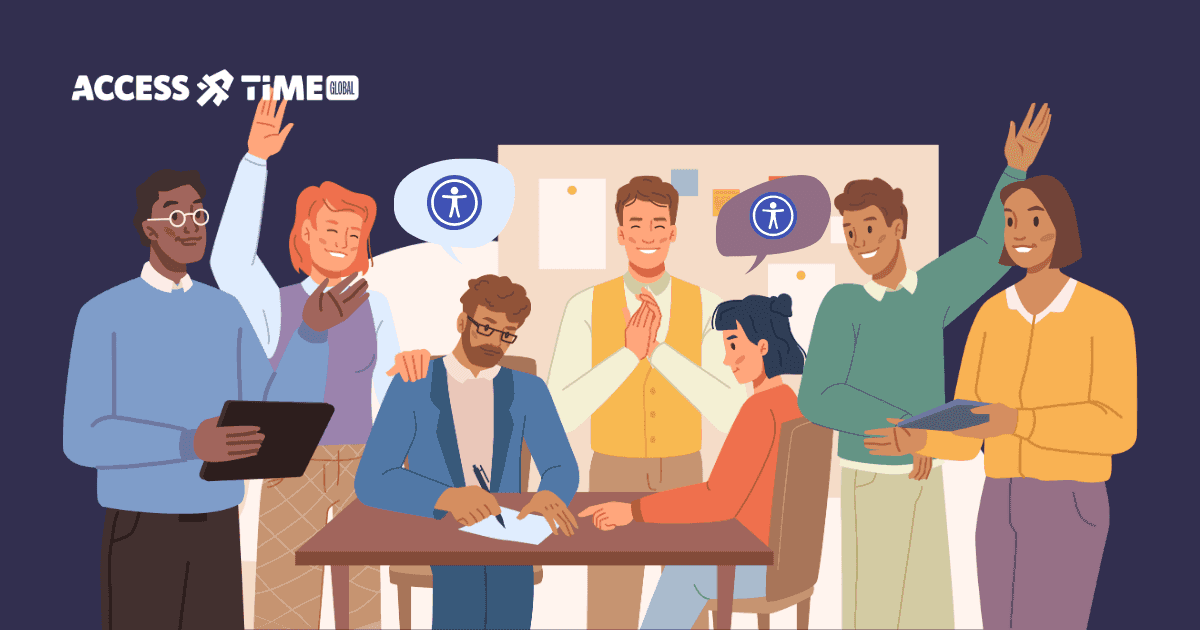
Another quiet advantage of accessibility-first teams is more reliable estimation. Teams that define states, errors, and edge cases upfront are less likely to be surprised later. They know what they are building before they build it. This reduces the accumulation of “small changes” that appear near deadlines and derail schedules.
What looks like extra work early is often just work that would have happened anyway. The difference is whether it happens intentionally or reactively.
Accessibility-first does not mean waiting for perfection. In practice, these teams are often better at progressive delivery. Because they understand the minimum viable behavior required for users to succeed, they can ship confidently without over-polishing. They know which compromises are acceptable and which are not. This clarity enables momentum without recklessness.
Decide Earlier, Regret Less
There is a reason mature software organizations increasingly treat accessibility as a core engineering discipline rather than a compliance layer. It sharpens thinking. It forces intent. It exposes weak decisions early, when they are still easy to fix. Teams that resist it are often not protecting speed, but protecting ambiguity.
And ambiguity is expensive. It compounds across QA, support, legal risk, and user trust.
The fastest teams are not the ones who rush. They are the ones who decide earlier and regret less. Accessibility, used properly, is not a drag on speed. It is one of the most reliable ways to achieve it.
Contact Us
Ready to explore how accessibility can transform your products? Visit our contact page to learn more about AccessTime consultancy services, or try Access Lens to get started with a fresh perspective on what's possible.
Share: